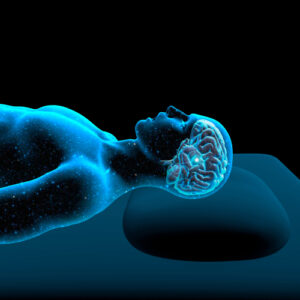
Have you ever had a gut feeling about something that turned out to be right? Perhaps you decide to drive a different way to work for no special reason. Later you find out there was a serious wreck on your regular route, and you may have been involved in the accident if you hadn’t gone a different way. Or, maybe you meet someone and without knowing anything about them you get a bad feeling and decide to discontinue the conversation. Later you find out they were less than honorable, and it was a good thing you weren’t connected with them any longer than you were. Where do these gut feelings come from? Does your gut know things your brain doesn’t? Or at least know them faster?
The phrase “gut feeling” carries a biological truth. Your gut contains over 200 million neurons (nerve cells), which is more than your spinal cord. Scientists call the gut your “second brain,” and it communicates with your actual brain via the longest nerve in your body called the vagus nerve, forming what researchers now call the “gut-brain axis.” But this biological highway isn’t one way, rather it is bidirectional conversation, i.e., brain to gut and gut to brain. This “conversation” happens all day, every day and shapes your feelings in your body and in your emotions. The bacteria living in your gut (38 trillion of them!) produce chemicals that affect how your brain works. For example, about 90% of your serotonin (a biochemical that controls mood) is made not in your head, but in your gut. In animal studies, researchers have found that when they change the gut bacteria, the animals also change. Timid mice become bold and bold mice become anxious.
So, when you feel butterflies in your stomach or a sinking feeling when something seems wrong, you’re experiencing one of the oldest communication systems in the human body … intuition. According to researchers, a gut feeling or intuition is a faster, instinctive form of intelligence that operates separately from our conscious thoughts. That means there’s another layer of knowing that does not wait for you to think! It acts on its own, and it seems that your gut is part of that system. Your brain is involved too though, just not in a traditional thinking sort of way. Neuroscientists have found that before you can reason or consciously recall something, your brain has already done the work.
The part of your brain called the limbic system sorts through all the information coming in, pulls out what it deems most important, and builds a rough picture of what’s going on. In other words, it creates a kind of a general overview of the situation or a gestalt. This primal part of your brain in essence comes up with a conclusion even before you know there’s a question. In a job interview, for example, the hiring manager may leave an interview feeling like something was “off” even though the candidate checks out on paper. Then later, after more reflection, the manager realizes every time she asked the candidate a question about his prior work experience, he broke eye contact and looked away. The manager missed that in real time, but her limbic system didn’t. Hence the uneasy or gut feeling.
Science backs this concept up. The right hemisphere of your brain is good at picking up patterns and anomalies even if you’re not consciously aware of it. In addition to the gestalt of the limbic system, your hippocampus compares the present situation with past similar experiences while the prefrontal cortex blends emotion with input to the brain. The result of all these brain areas working together is often a feeling rather than a thought. It’s a type of rapid, unconscious processing. Chess grand masters can evaluate a game board in five seconds and know the best move. Doctors, firefighters, and plenty of other people who have lots of experience with a situation are able to do the same quick evaluation. If you ask them how they do it, they’ll say, “I just knew.” And that’s true, but this is how they “know.”
Your brain doesn’t just sit there waiting for information to arrive. Rather, it proactively predicts what it expects to see based on what it has learned, and when reality doesn’t match the prediction, that mismatch surfaces as a feeling or a hunch. So, one way to understand intuition is this: Your brain’s pattern recognition system works faster than your conscious mind. It reaches an answer first and sends you a feeling while your thinking catches up.
But there’s another aspect of intuition that’s harder to explain. The military has coined the term “precognition” or the “spidey sense” as a description for how soldiers survive in the field when they act on feelings they can’t explain. For example, they choose not to go in a certain direction based on a feeling and later find out that path was covered with landmines. Some researchers call this spidey sense “memories from the future,” indicating that unlike our prior discussion, somehow these soldiers get a feeling about a situation they haven’t experienced before. Something is going on in these circumstances that current neuroscience can’t explain.
Even without a scientific explanation though, some groups are developing programs to help people (especially children) learn to develop and grow their intuition through practice. One such group is the Institute of Absolute Intelligence. Formal programming not withstanding, one thing we can all do to develop our intuition is to pay close attention to our own thoughts and everything around us. Most of us are so distracted that we may not notice intuitive feelings even if we have them. And remember that intuition also needs discernment. In other words, logic and feelings should co-exist. It’s unwise to just focus on the feelings aspect of intuition. We need to be able to discern the difference between a real intuitive signal, fear, a personal bias, or wishful thinking. Research has shown that we get the best outcomes when we combine rational analysis with intuitive judgment.
Interestingly, many EESystem users across the globe report improved intuition, mental clarity, and emotional balance from their time with the technology. One other suggestion we’d like to add is to develop your prayer life and ask our Creator for wisdom and discernment in evaluating the best course of action. The more often we use that divine communication channel, the more open it becomes and the better we are at tuning into His messages.
Reference Source: https://youtu.be/BvUDkM9ORxw?si=TFy_sFVpJOmckn7r